
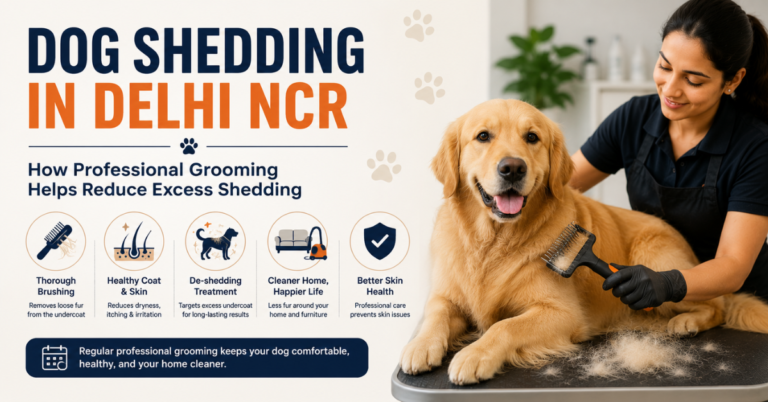
Dog shedding in Delhi NCR is one of the biggest concerns for pet parents, especially if you own a Labrador, German Shepherd, Golden Retriever, Husky, or other double-coated breed. Delhi’s climate, seasonal changes, and pollution can increase shedding throughout the year. This guide explains dog shedding in Delhi NCR, why it happens, and how professional grooming helps reduce loose fur while keeping your dog’s coat healthy.
Shedding is a completely natural biological process — you cannot stop it. But you can reduce it dramatically. A professional deshedding treatment, done correctly and consistently, can reduce the amount of fur your dog sheds at home by up to 70% for the weeks following each session. This guide explains exactly why Delhi dogs shed as much as they do, what professional deshedding actually involves, and how to manage shedding between sessions.
Why Dog Shedding in Delhi NCR Is More Common Than You Think
Shedding is triggered primarily by two things: changes in daylight hours and changes in temperature. As days get longer or shorter, and as temperatures shift significantly, a dog’s body reads these environmental signals and initiates coat transition — loosening the old coat to make way for the new one.
Delhi’s climate creates a shedding environment that is more intense than most cities in the world:
Extreme seasonal temperature swings
Delhi goes from near-freezing winter nights in January to 45°C summer days in May. This is one of the widest temperature ranges of any major city in the world, and double-coated breeds respond to these extremes with correspondingly intense coat transitions. A Labrador in Delhi sheds more heavily and more frequently than the same breed in a temperate European city — not because of anything wrong with the dog, but because the climate is more extreme. According to the American Kennel Club, temperature and daylight changes are the primary biological triggers for seasonal shedding in dogs.
Two distinct shedding peaks per year
Most double-coat breeds in Delhi experience their heaviest shedding during March–April as temperatures rise sharply after winter, and again in October–November as the coat adjusts post-monsoon going into cooler weather. During these 4–6 week windows, the undercoat loosens completely and exits the coat in clumps. This is what GSD and Lab owners describe as “fur everywhere suddenly” — it is not random, it follows a pattern every year.
Year-round dust and pollution
Delhi’s air quality means that dust and pollution particles settle continuously into double coats. This debris accumulates in the undercoat, making it heavier, duller, and more irritating to the skin. It also clogs the natural airflow between the undercoat and skin, causing the dog to overheat more easily in summer — which in turn stimulates more shedding as the body tries to thin the coat.
Hard water effects on coat health
Delhi’s hard water supply strips coat oils during bathing when the wrong shampoo is used. Dry, brittle hair breaks off more easily and sheds at a higher rate than well-conditioned hair. This is a factor many pet parents do not consider — yet it is one reason dog shedding grooming Delhi professionals recommend breed-appropriate shampoos specifically formulated for hard water conditions.
How to Control Dog Shedding in Delhi NCR at Home
Many dedicated pet parents brush their dogs daily and still find fur everywhere. This is not a failure of effort — it is a limitation of what brushing alone can achieve.
A slicker brush or bristle brush works on the outer coat — the top layer of guard hairs. It removes loose surface hair effectively and helps distribute coat oils. What it cannot do is reach and remove the dense, compacted dead undercoat that sits close to the skin.
The undercoat is where most bulk shedding comes from. This is the soft, dense layer that loosens during shedding season and gradually releases in large quantities over several weeks. Brushing stimulates some of this release but cannot remove compacted dead undercoat the way professional treatment can. The undercoat needs to be loosened at the root level — which requires a specific combination of products and equipment that only professional grooming provides.
Think of it this way: home brushing manages surface shedding. Dog shedding grooming Delhi professionals provide treats the source — the compacted dead undercoat that no brush can reach. Both are necessary and work together.
Professional Grooming for Dog Shedding in Delhi NCR
A professional deshedding session is a specific multi-step process, and each step matters. Here is exactly what happens during a professional dog grooming deshedding session at home:
Step 1 — Pre-bath brushout
Before the bath, the groomer does an initial brushout to remove surface loose fur and check for mats. Any tangles are worked through at this stage — bathing a matted coat tightens the mats, so they need to be addressed first. This also gives the groomer a chance to assess how much undercoat is present and how the session should be approached.
Step 2 — Deshedding shampoo bath
The dog is bathed using a specialist deshedding shampoo formulated to penetrate through the outer coat to the undercoat level, loosening the bond between dead undercoat hair and the follicle. These shampoos are completely different from standard products — using a regular shampoo during dog shedding grooming Delhi sessions significantly reduces the effectiveness of the treatment. The shampoo is worked all the way through to the skin, not just the surface of the coat.
Step 3 — Deshedding conditioner
After rinsing the shampoo, a deshedding conditioner is applied. This further loosens the dead undercoat while hydrating the skin and coat. It also reduces static — a major factor in why shed hair clings to fabric and surfaces. The conditioner sits for several minutes to work fully before rinsing.
Step 4 — High-velocity blow-dry (the most critical step)
This is where the visible result happens. A high-velocity dryer — which moves a very high volume of air without excessive heat — is used to systematically work through the coat section by section. The force of the airflow physically blasts loose dead undercoat out of the coat as it dries. For a heavily shedding Labrador or German Shepherd, the volume of fur that comes out during this stage alone is remarkable — what would otherwise shed gradually over the next 4–6 weeks comes out in a single controlled session.
The high-velocity dryer is what makes professional dog shedding grooming in Delhi genuinely different from everything a pet parent can do at home. No consumer-grade hairdryer creates the same airflow, and without it, the loosened undercoat simply dries back into the coat and continues shedding normally over the following weeks.
Step 5 — Deshedding brushout
After drying, the groomer works through the coat with a deshedding brush or undercoat rake to remove any remaining loose fur. This final stage leaves the coat smooth, light, and significantly reduced in volume.
What the result looks like
After a full professional deshedding session, the coat looks visibly lighter and flatter. For the 4–6 weeks following a session, dog shedding at home in Delhi is reduced by up to 70% compared to before the treatment. The exact reduction varies by breed, individual coat condition, and season.
Best Dog Breeds Affected by Dog Shedding in Delhi NCR
Deshedding treatment is specifically designed for double-coat and heavy-shedding breeds. It does not apply to single-coat or non-shedding breeds like Poodles, Maltese, or Shih Tzus — those breeds have different coat needs entirely.
- Labrador Retriever — the most common breed in Delhi NCR and one of the heaviest shedders. A single deshedding session on a Lab that has not had professional treatment in 2–3 months produces a startling volume of removed fur.
- German Shepherd — extremely heavy seasonal shedder with a dense undercoat that requires both the deshedding treatment and complete blow-drying to prevent skin issues. During shedding season, monthly dog shedding grooming sessions in Delhi are the right interval for GSDs.
- Golden Retriever — similar to the GSD in coat density but with longer feathering. Golden Retrievers in Delhi are also prone to hotspots during monsoon humidity, and regular deshedding reduces the compacted damp undercoat that contributes to this.
- Husky — Huskies living in Delhi experience significant coat stress from the heat. Their double coat blows completely twice a year. Despite the temptation, never shave a Husky — the double coat insulates against heat as well as cold when properly maintained. Professional deshedding is the only correct approach. The AKC confirms that shaving double-coat breeds can permanently alter coat texture.
- Pomeranian — despite their small size, Pomeranians carry a very full, dense double coat that benefits significantly from professional deshedding. The volume of undercoat relative to body size is remarkable.
- Dalmatian — shed constantly and the fine white hairs embed in fabric particularly effectively. Professional deshedding significantly reduces the volume of hair released at home over the following weeks.
- Beagle and Indian Indie Dog — both shed moderately and benefit from deshedding treatment during peak seasons even though they do not have the same undercoat density as double-coat breeds.
How Often Should You Groom Dogs with Dog Shedding in Delhi NCR?
| Period | Heavy Shedders (GSD, Lab, Golden, Husky) | Moderate Shedders (Beagle, Indie, Dalmatian) |
|---|---|---|
| Normal periods | Every 6–8 weeks | Every 8 weeks |
| Shedding season (Mar–Apr, Oct–Nov) | Every 3–4 weeks | Every 6 weeks |
| Delhi summer (Apr–Jun) | Every 6 weeks | Every 8 weeks |
| Monsoon (Jul–Sep) | Every 4–6 weeks + tick treatment | Every 6–8 weeks + tick treatment |
Deshedding treatment can be included as part of any full grooming session or booked as a dedicated add-on. For dogs in peak shedding season, booking a standalone deshedding session between regular appointments makes a significant difference to how much fur ends up in your home.
Home Maintenance Between Dog Shedding Grooming Delhi Sessions
Professional deshedding removes the deep undercoat buildup — but maintaining results between sessions requires consistent home care. Here is what actually works:
Brush 3–4 times per week
Use a slicker brush for the outer coat and a deshedding rake or undercoat comb once a week. Ten minutes of brushing three times a week makes a visible difference to how much fur ends up on furniture — and significantly extends the results of each professional session.
Omega-3 fatty acid supplementation
Coat health directly affects shedding rates. Dogs with well-nourished coats shed at lower rates because well-conditioned hair stays anchored in the follicle longer. Fish oil supplements with EPA and DHA improve coat condition significantly over 8–12 weeks of consistent use. Consult your vet for the correct dosage for your breed and size.
Keep your dog well hydrated
Dehydration is one of the most overlooked drivers of excessive shedding between dog shedding grooming Delhi appointments — particularly in summer. A dehydrated dog’s skin becomes dry and hair follicles weaken, releasing hair more readily. Always provide access to fresh, cool water. Many dogs drink more when water is changed frequently — stale water in Delhi’s summer heat is less appealing and reduces intake.
Use breed-appropriate shampoo at home baths
If you bathe your dog at home between professional sessions, use a moisturising, pH-balanced dog shampoo appropriate for your breed’s coat type. Avoid human shampoos entirely — the pH of human skin (4.5–5.5) is significantly different from a dog’s skin (6.2–7.4), and human shampoo strips the coat and accelerates shedding. Delhi’s hard water already stresses the coat — using the wrong shampoo compounds this significantly.
Diet quality matters
Dogs fed a high-quality diet with adequate protein, healthy fats, and micronutrients have better coat condition than dogs on lower-quality food. Coat condition is one of the first visible indicators of nutritional adequacy — if shedding seems excessive regardless of grooming frequency, a diet review with your vet is worth considering.
FAQs About Dog Shedding in Delhi NCR
Can professional grooming completely stop my dog from shedding?
No — and anyone who claims it can is being dishonest. Shedding is a biological process that cannot be stopped. What professional dog shedding grooming in Delhi does is remove the bulk of the dead undercoat in a single controlled session, so the fur that would otherwise shed gradually over 4–6 weeks comes out all at once during the grooming appointment rather than on your furniture. The result is up to 70% less shedding at home — but some ongoing shedding remains normal for these breeds.
My dog sheds all year, not just in shedding season. Is something wrong?
Year-round shedding is completely normal for double-coat breeds. The seasonal peaks in March–April and October–November are more intense, but continuous moderate shedding throughout the year is the breed’s normal pattern. If shedding is suddenly dramatic, accompanied by bald patches, or involves skin changes, a vet check is worth scheduling — but steady year-round shedding in a Labrador or GSD in Delhi is entirely normal.
I brush my dog every day. Why does fur still end up everywhere?
Because brushing only addresses the outer coat. The source of bulk shedding — compacted dead undercoat beneath the guard coat — cannot be removed by brushing alone. It requires the deshedding shampoo and high-velocity dryer combination that professional dog shedding grooming in Delhi provides. Daily brushing is genuinely valuable and reduces surface shedding, but it is not a substitute for professional deshedding treatment.
Is it okay to shave my Labrador or Husky to reduce shedding?
No — this is one of the most common and damaging mistakes Delhi pet parents make in summer. Shaving a double-coat breed removes the outer guard coat that protects skin from UV radiation and helps insulate against heat. It also frequently causes “coat blow” — a condition where the coat grows back in an abnormal texture, sometimes permanently. The double coat, when properly maintained through professional deshedding, actually helps keep the dog cooler in summer. Never shave a double-coat breed.
How long do the results of a deshedding session last?
For most heavy-shedding breeds in normal conditions, the reduced shedding effect lasts 4–6 weeks. During peak shedding season in Delhi, the undercoat replenishes faster and the effect may last 3–4 weeks. This is why more frequent sessions during March–April and October–November are recommended for GSDs, Labs, and Golden Retrievers in Delhi.
Why does at-home deshedding work better than salon deshedding?
Several reasons. At-home dog grooming means your dog is calm in a familiar environment — and a relaxed dog is genuinely easier to work with throughout a 60–90 minute deshedding session than a stressed dog in an unfamiliar salon. The groomer can take the time the session requires without back-to-back appointment pressure. And the significant volume of fur removed is managed and cleaned during the session at your home, rather than becoming a logistical issue at a salon.
Book Dog Shedding Grooming Delhi — TailsGroom At-Home Service
TailsGroom provides professional deshedding treatment as part of any full grooming session or as a dedicated add-on. Our groomers come to your home across Delhi NCR with high-velocity dryers, specialist deshedding shampoos, and undercoat rakes — everything needed for a genuinely effective dog shedding grooming session in Delhi.
We serve Delhi, Noida, Gurgaon, Greater Noida, Ghaziabad, and Faridabad.
📞 Call or WhatsApp: 9220234013 to book your dog’s deshedding session.