
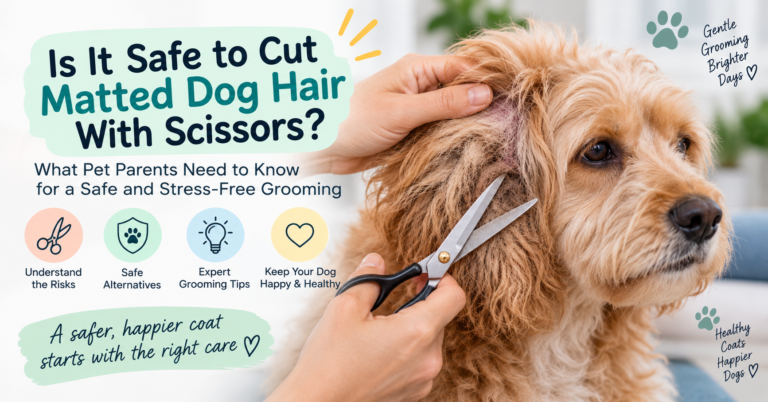
You’ve found a tight, stubborn mat on your dog, and your first instinct is to grab the kitchen scissors and just cut it out. Before you do, it’s worth pausing — because the way you cut matted dog hair matters just as much as whether you cut it at all.
This is one of the most common questions pet parents ask, and for good reason. Mats often sit closer to the skin than they appear, and a fast, well-meaning snip can lead to an accidental injury. This guide walks through when scissors are safe, when they’re not, and how to remove dog mats safely without a trip to the emergency vet.
Table of Contents
- The Short Answer
- Why Scissors Are Riskier Than They Look
- When It Might Be Okay to Cut a Mat
- When You Should Never Use Scissors
- How to Remove Dog Mats Safely
- Tools That Are Safer Than Scissors
- What to Do If You Accidentally Cut the Skin
- How to Prevent Dog Matting in the First Place
- When to Call a Professional Groomer or Vet
- Frequently Asked Questions
The Short Answer
In most cases, using scissors to cut matted dog hair is not recommended. Mats sit closer to the skin than they appear from the outside, and a dog’s skin is thin, loose, and prone to sudden movement — a combination that makes it easy to nick or cut the skin without meaning to.
There are safer tools designed specifically for this job, and in many cases, they work just as fast as scissors without the same risk.
That said, scissors aren’t always off the table. The right answer depends on the mat’s size, location, and how close it sits to the skin — all covered below.
Why Scissors Are Riskier Than They Look
Scissors seem like the obvious tool for a tangled clump of fur, but a few factors make them more dangerous than they first appear.
Mats Hide How Close They Are to the Skin
A mat can look like it’s floating an inch above the skin when, in reality, the tangled fur is pulling the skin up into the knot itself. Cutting into what looks like “just hair” can mean cutting into skin that’s been drawn upward by the tension of the mat.
Dogs Move Unpredictably
Even the calmest dog can flinch, shift, or shake when they feel scissors near sensitive areas like the ears, armpits, groin, or paws. A sudden movement during a cut is one of the most common causes of accidental injury.
Straight-Blade Scissors Leave No Margin for Error
Standard scissors have sharp points and offer very little buffer between the blade and the skin. Unlike blunt-tipped grooming shears, there’s no built-in safety margin if the dog moves or the mat sits closer to the skin than expected.
Severe Mats Can Already Be Irritating the Skin
Tight mats often trap moisture and cause redness or tenderness in the skin underneath. Cutting near already-irritated skin increases both the pain and the risk of injury. The American Veterinary Medical Association advises that mats be removed carefully to avoid injuring skin that may already be compromised.
When It Might Be Okay to Cut a Mat
Cutting isn’t automatically off-limits — it depends heavily on the situation. Scissors (ideally blunt-tipped grooming scissors, not household ones) may be reasonable when:
- The mat is small, loose, and clearly separated from the skin
- You can easily slide a comb between the mat and the skin
- The area isn’t near the eyes, ears, groin, or other sensitive zones
- Your dog is calm, comfortable being handled, and not in pain
Even in these lower-risk situations, cutting parallel to the skin — never straight down into it — is essential.
When You Should Never Use Scissors
Skip the scissors entirely and move to a safer method or a professional if:
- The mat is tight, thick, or “felted” directly against the skin
- You can’t fit a comb between the mat and the skin
- The mat is located near the eyes, ears, mouth, groin, or paw pads
- Your dog reacts with pain, flinching, or aggression when the area is touched
- The skin underneath looks red, raw, or irritated
- Multiple mats cover a large section of the body
In any of these cases, the safest option is a wide-tooth comb, a dematting tool, or a trip to a groomer — not a pair of scissors.
How to Remove Dog Mats Safely
If the mat is small and loose enough to attempt at home, here’s a step-by-step approach that minimizes risk:
- Slide two fingers underneath the mat, between the tangle and the skin, to act as a protective barrier.
- Apply a detangling spray or a small amount of cornstarch to loosen the fur and reduce pulling.
- Gently separate the mat with your fingers, working from the outer edge inward.
- Use a wide-tooth comb to work through the loosened sections, always combing away from the skin.
- Switch to a dematting tool for any remaining tangled fibers, using short, gentle strokes.
- Stop immediately if your dog shows signs of pain or if the mat isn’t loosening — this is a sign it needs professional attention.
This slower approach takes more patience than scissors, but it’s the method most likely to remove dog mats safely without injury.
Tools That Are Safer Than Scissors
A few tools are purpose-built to reduce the risks that come with standard scissors:
- Blunt-tipped grooming scissors — rounded tips reduce the chance of poking the skin if your dog moves
- Dematting combs — feature small, curved blades that slice through tangled fur while a comb-like guard protects the skin
- Wide-tooth combs — help separate mats gently before any cutting is attempted
- Detangling sprays or conditioners — soften fur and reduce friction, making mats easier to work through without cutting at all
Investing in even one of these tools makes future mat removal significantly safer than reaching for household scissors.
(Related: Our Guide to Grooming Tools for Every Coat Type)
What to Do If You Accidentally Cut the Skin
Accidents can happen even with careful technique. If a cut occurs:
- Apply gentle, direct pressure with a clean cloth to control bleeding
- Avoid using human antiseptics unless your vet has specifically approved them for pets
- Keep your dog calm and still to prevent the wound from reopening
- Contact your veterinarian promptly, especially if the cut is deep, won’t stop bleeding, or is near the eyes or ears
Most small nicks heal without complication, but it’s always worth a quick call to your vet to be safe. The ASPCA Animal Poison Control and pet care resources offer additional first-aid guidance for minor at-home injuries.
How to Prevent Dog Matting in the First Place
The best way to avoid the “should I cut this mat” dilemma altogether is to prevent mats before they form.
Brush regularly and thoroughly. Aim for two to three sessions a week for most coats, and daily for long-haired or curly breeds.
Pay attention to high-risk areas. Behind the ears, under the collar, the armpits, and the groin are common spots where mats develop first.
Dry your dog completely after baths or swimming. Damp fur tangles far more easily than dry fur.
Use a comb before and after bath time. Water tightens existing tangles, so combing beforehand prevents small knots from becoming set-in mats.
Schedule regular grooming appointments. For breeds prone to matting, a professional trim every four to eight weeks keeps the coat manageable between visits.
(See also: Why Does My Dog’s Fur Get Matted Behind the Ears? for a deep dive on the most common matting hotspot.)
When to Call a Professional Groomer or Vet
Some mats are simply outside the scope of a safe at-home fix. Call a professional if:
- The mat is large, tight, or covers a significant area of the body
- Cutting or combing hasn’t loosened it after a reasonable attempt
- Your dog is in visible pain or won’t tolerate handling near the mat
- You notice redness, swelling, odor, or broken skin underneath the mat
Groomers have specialized clippers and dematting tools designed for exactly these situations, and vets can address any skin issues a mat may have caused. There’s no harm in asking a professional to handle a mat you’re unsure about — it’s a far safer choice than risking an injury at home. The National Dog Groomers Association of America maintains a directory of certified groomers if you need to find one nearby.
Frequently Asked Questions
Is it ever safe to cut matted dog hair myself? Yes, but only for small, loose mats that sit clearly away from the skin. Tight, skin-level mats are safer left to a groomer or removed with a dematting comb rather than scissors.
What’s the safest tool to remove dog mats safely at home? A wide-tooth comb combined with a detangling spray is generally the safest starting point. A dematting comb with a protective guard is a good next step for tougher tangles.
Can matted fur cause skin problems if left too long? Yes. Tight mats trap moisture and restrict airflow, which can lead to irritation, odor, or infection in the skin underneath over time.
Should I shave a badly matted dog instead of cutting individual mats? For severe or widespread matting, a groomer will often recommend a full shave-down. It’s usually safer and more comfortable for the dog than trying to cut out each mat individually.
The Bottom Line
Reaching for scissors feels like the fastest fix when you find a mat, but it’s often the riskiest one. In most cases, a wide-tooth comb, a dematting tool, and a little patience will remove dog mats safely without putting your dog’s skin at risk. When a mat is tight, widespread, or close to sensitive areas, a professional groomer is worth the trip — it’s a far better trade-off than an accidental cut.