
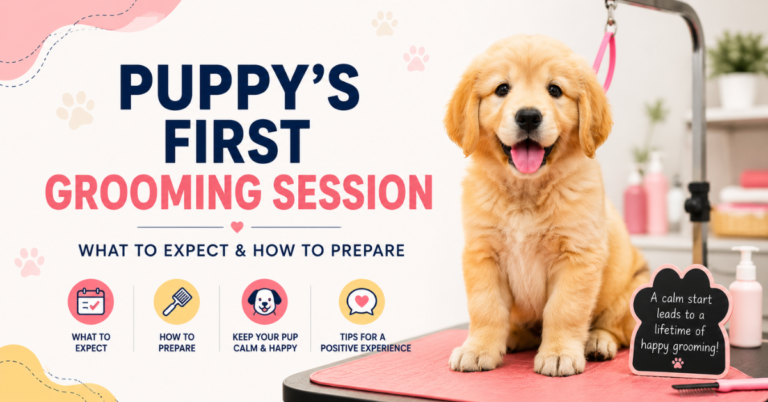
Puppy first grooming in Delhi is one of the most important experiences of your dog’s early life — not because of how they look afterwards, but because of how they feel about it.
This guide walks you through everything — when to start, how to prepare your puppy at home, what a good first session actually looks like, and why where you get it done matters more than most people realise.
When Should You Start Grooming Your Puppy?
The ideal window for a puppy’s first professional grooming session is between 10 and 16 weeks of age — once their initial vaccinations are complete.
This timing is not random. Puppies go through what behaviourists call a socialisation window between 3 and 16 weeks of age. During this period, their brains are actively forming associations with new experiences. Positive experiences during this window get locked in as “safe and normal.” Negative or frightening experiences during this window also get locked in — and are significantly harder to undo later.
In simple terms: a puppy who has a calm, gentle first grooming experience at 12 weeks is far more likely to be an easy-to-groom adult dog than one whose first session happens at 6 months in a stressful environment.
The earlier you start — gently and correctly — the better.
What if my puppy’s vaccinations aren’t done yet?
At-home dog grooming is actually the safest option during this phase. Because the groomer comes to your home, your puppy is not exposed to other animals or unfamiliar outdoor environments. You can begin professional grooming at home even before the full vaccination schedule is complete — something that would not be possible at a salon where other dogs are present.
How to Prepare Your Puppy Before the First Session
The single most effective thing you can do before the first grooming appointment is get your puppy comfortable with being touched all over their body. This is called handling desensitisation, and it takes less than five minutes a day for a week.
Here is exactly what to do:
1. Touch every part of their body — daily
Run your hands along their back, sides, belly, and chest. Gently pick up each paw and press the individual toes softly — this mimics nail trimming. Look inside the ears. Touch around the muzzle and lift the lips gently to see the teeth. Stroke the tail from base to tip. Do this while they are calm and relaxed, not when they are excited or playful.
2. Introduce grooming tools before the session
Place a brush, comb, or nail clipper on the floor and let your puppy sniff and investigate it freely. Associate the tools with treats. The goal is that when the groomer brings out a brush on grooming day, your puppy already knows what it is and has no reason to be afraid of it.
3. Practise short bath-time moments
Even just running warm water over your puppy’s paws in the sink or bucket — with treats and praise — helps them associate water with something calm and positive. You are not trying to bathe them fully. You are just making water feel normal.
4. Use treats generously
During all of this preparation, pair every new touch and sensation with a treat. High-value treats — small pieces of boiled chicken or paneer work very well — are more effective than biscuits during this kind of training. The puppy’s brain is learning: paw being touched = something good happens. That association carries directly into the grooming session.
5. Keep it short and positive
Do not push through resistance. If your puppy pulls a paw away, let them. Try again in a moment with a treat. Forcing handling at this stage creates exactly the kind of negative association you are trying to avoid. End every session on a positive note — even if that means stopping after 60 seconds.
What Actually Happens During a Puppy’s First Grooming Session?
A first grooming session for a puppy should look quite different from a standard adult grooming session. If a groomer treats your 12-week-old puppy the same way they would treat a three-year-old adult dog — moving quickly, working through the full session regardless of stress signals — that is a red flag.
Here is what a well-run puppy first session looks like, step by step:
Step 1 — Introduction and settling (5–10 minutes)
Before any grooming begins, the groomer should spend time simply letting the puppy get comfortable with them. This means sitting at the puppy’s level, allowing sniffing, offering treats, and talking calmly. No tools. No bath. Just building trust. At TailsGroom, our groomers are trained to read puppy body language during this introduction — a puppy that is wagging, sniffing curiously, and accepting treats is ready to proceed. A puppy that is cowering, freezing, or trying to escape needs more settling time first.
Step 2 — Gentle bath
The bath uses warm water (not cold, not hot — lukewarm and comfortable), a gentle puppy-appropriate shampoo, and a slow, calm approach. The groomer speaks to the puppy throughout. There is no rushing. The goal is that the puppy’s first experience of a professional bath feels safe.
Step 3 — Blow dry — the most important part to get right
This is where many first sessions go wrong. Industrial cage dryers used in salons are extremely loud and can genuinely frighten puppies. A professional at-home groomer uses a handheld dryer on a low, warm setting — held at a comfortable distance, introduced gradually, and paired with treats. Your puppy should not be terrified of the dryer after their first session. If they are, the approach was wrong.
Step 4 — Light brushing
After drying, a gentle brushout helps the puppy get used to the sensation of a brush. For short-coated breeds this takes just a couple of minutes. For long-coated breeds like Shih Tzus, Lhasa Apsos, or Pomeranians, this step is especially important to establish early — matting becomes much harder to deal with if brushing is not introduced from puppyhood.
Step 5 — Nail trimming
Puppy nails are small and thin and trim easily. A good groomer does this quickly and calmly. If the puppy is very distressed, a skilled groomer may trim just the front nails in the first session and leave the back for next time. Partial completion with a calm puppy is always better than full completion with a frightened one.
Step 6 — Ear cleaning
A basic ear cleaning — checking and gently wiping the outer ear canal — is included in most first sessions. This is also an early health check: a trained groomer will notice early signs of ear infection, excess wax, or moisture that you may have missed.
What if the puppy gets too stressed to continue?
This is completely normal and a good groomer will tell you this upfront. Tailsgroom groomers are trained to recognise stress signals — excessive panting, trembling, attempts to escape, shutting down — and will pause or end the session if needed. A puppy that has half a grooming session and goes home calm has had a successful first experience. A puppy that has a full session and goes home traumatised has not.
Why Puppy First Grooming in Delhi Should Happen at Home
For adult dogs, at-home grooming is more convenient and less stressful. For puppies, it is genuinely the more responsible choice — and here is why.
Puppies are in the middle of forming their understanding of the world. Every new environment, sound, smell, and interaction is being filed away in their developing brain as either “safe” or “threatening.” A busy grooming salon — with barking dogs in crates, industrial dryer noise, unfamiliar animals, and multiple strangers — is an overwhelming environment for a young puppy during the most sensitive period of their life.
At-home dog grooming removes every one of those stressors. Your puppy is in their own home — the place they feel safest. You are present. There are no other animals. The groomer focuses entirely on your puppy. The session is quieter, calmer, and at the puppy’s pace.
The first few grooming sessions shape the relationship your puppy has with grooming for the rest of their life. Getting those first sessions right — at home, with a trained, patient groomer — is one of the most valuable things you can do for your dog’s long-term wellbeing.
A Note on Different Breeds
Not all puppies have the same grooming needs, and knowing your breed’s requirements helps you start on the right foot.
Long-coated breeds (Shih Tzu, Lhasa Apso, Pomeranian, Golden Retriever, Cocker Spaniel) — grooming should start early and happen frequently. These coats mat quickly, and a puppy that is not used to regular brushing and trimming becomes very difficult to groom as an adult. Monthly professional sessions from 10–12 weeks onwards are ideal.
Short-coated breeds (Labrador, Beagle, Indian Pariah, Dobermann) — grooming needs are simpler, but regular nail trimming, ear cleaning, and occasional baths are still important. Starting early makes these routine checks easy throughout the dog’s life.
Double-coated breeds (Husky, German Shepherd) — these puppies shed significantly and benefit enormously from early deshedding brush sessions. Introducing the brush and blow-dry during puppyhood prevents the deshedding process from becoming a battle later.
What to Do After the First Grooming Session
The session ending well matters just as much as the session itself. Here is what to do once the groomer leaves:
- Praise extensively. Make a big fuss of your puppy immediately after. Happy voice, gentle petting, their favourite treat. You are reinforcing the association: grooming session = wonderful things happen afterwards.
- Let them rest. Grooming is genuinely mentally tiring for puppies. Do not take them for a walk or invite guests over immediately after. Give them a quiet couple of hours to decompress.
- Avoid heavy handling of groomed areas for 24–48 hours. Let the positive experience settle. Do not attempt to brush them yourself right after — save that for the following day when they are rested.
- Book the next session within 4 weeks. Consistency is key during puppyhood. Regular, positive grooming sessions during the first few months build habits that stick for life. Waiting three months between sessions in this phase means each one feels new and unfamiliar again.
Signs Your Puppy Had a Good First Session
After a well-handled puppy first grooming session in Delhi, your puppy should:
- Eat and drink normally within an hour
- Be curious and playful (possibly after a short nap)
- Not show obvious fear when grooming tools are visible in the following days
- Allow you to touch their paws, ears, and face without flinching
If your puppy is hiding, refusing food, or showing prolonged fearful behaviour after a grooming session, the session was too stressful. This is worth discussing with your groomer so the next session is adjusted accordingly.
Book Your Puppy First Grooming in Delhi with Tailsgroom
Tailsgroom groomers are experienced with puppies and trained in fear-free, low-stress handling techniques. We come directly to your home — the safest, calmest environment for your puppy’s first experience. No crates, no strange dogs, no industrial noise. Just your puppy, in their own space, with a patient and trained professional.
We serve Delhi, Noida, Gurgaon, Greater Noida, Ghaziabad, and Faridabad.
📞 Call or WhatsApp: 9220234013 to book your puppy’s first session.